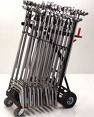
Today's post is a guest post. I haven't been able to post as much, or prepare anything for a few weeks so I asked my buddy Greg Brooks to fill-in. Greg is a Dolly Grip's Dolly Grip. His credits include: the Showtime series Californication, and the Clint Eastwood films, Changeling and Gran Torino. He knows his stuff, you should listen to him.
CRANE MARKING
"Good luck!"
A big part of what we do as dolly grips is operate camera cranes and jib arms. These too require the same soft touch and subtle corrections as a dolly but now you have to fight (or befriend) gravity and inertia. It can be quite challenging. Often times you are on a wide lens and you can wing it and get it close, but often times you are not and pin point precision placement is key and settling that crane into an over from thirty feet in the air is a skill like any other that challenges us as dolly grips. I've learned a few key tricks that can aid you immensely as a "bucket guy." This of course refers to the guy that is operating the crane and doing the primary arm movements from the handles at the rear of the crane. First thing I do is try to pick the back corner of the bucket that is between the action and the crane. Once a number one position is established by whomever is calling the shots, depending on the ground surface, I'll give myself a T-Mark (like the ones we use for actors) on the ground so I always come back and stand in the same place. Any mark will do, but the key is to have your feet in the same place every time because the camera can look like it's in the same place from thirty feet away from different foot positions. Secondly I look up at the camera which is where your eyes are going to be focused and match a vertical or horizontal line on the camera or the head with a vertical or horizontal line in the background. Sometimes it's the front of the matte box or the base of the head or anything like that. Then you just look beyond those two things and see what they fall in line with. The trick here is to not mark off objects that can move!! This is a mistake that we've all made a million times. Sometimes you'll mark off the top of a truck that you're sure will never move and then the 2nd A.D. comes out right before they yell, "Rolling!!" and asks for that truck to be backed up five feet!! Always stick with inanimate objects. I can't stress that one enough. I've been burned more times than I can think and my B-Dolly grip and I always tell stories about the times we've been burned by marks. The other thing you can do as a back up or as a primary mark is measure off your own body since sometimes the only thing to mark your first position off of is blue sky. So I make a note of where the back handle rubs against my side and remember the position. This is handy, but way less precise when you get into the very tight shots that your number two position is often establishing. So once your number one position is established, there will always be a number two and sometimes a three and four. I use the same procedure for all. The floor marks are really key for me because you can step into the mark as you are swinging around and then shift your eyes to the camera and land it in the exact place that you want and already have your feet planted so you can use your upper body strength to softly slide the camera to it's last mark. This system works pretty well for me. Again, I'd like to reiterate something that is stated on this site many times about being a good dolly grip. The most important part of all this is knowing what the shot is trying to achieve and knowing your lenses and what the shot will see at all your positions. I look forward to hearing some new methods from everyone.
Saturday, April 24, 2010
Friday, March 26, 2010
Freeballing
In my experience, there are basically two kinds of shows. Those where the shots are meticulously planned out, and those where they aren't. On most sets, the director and DP plan out the shot with a finder. You get your marks. You know exactly what's going to happen and have a vague idea of where the camera needs to be at specific points during the shot. On others, the director or DP gives a vague wave of the hands and says, "Start here and go over here." You look at the Camera Operator and he rolls his eyes and mouths, "Good luck." Needless to say, the first kind are the easiest for me, although not always the most challenging. I'm presently doing the latter. It's a comedy with two high profile comedy directors (figure that one out). They are both great guys and the DP is a joy to work with. But there is a lot of vague hand waving and pronouncements of, "Start here and maybe we won't see the track." The Camera Operator, who is honestly one of the best in the world rolls his eyes and....well, you know the rest. The beauty of this system is the fun of not really knowing what is going to happen and having to adjust the shot as it unfolds. It gives the Dolly Grip more creative control over the shot and your skills really come into play. This style is affectionately known as freeballing. God bless my Camera Operator. He honestly asks my opinion about shots and framing and gives me the freedom to make split second decisions as the scene unfolds. It can get a little frustrating sometimes, though, because I never really know what to set up because the rehearsals are so vague. What can be difficult is coming from a very rigid form of working to this freewheeling type of shooting. I've done movies where the camera placement was critical down to the inch. I was literally measuring the rooms to make sure I knew where the exact, symmetrical center was. You learn very quickly to look for clues as to where the camera should be- lighting fixtures or tiles in the floor are great indicators for lining up a symmetrical shot. It can be hard, though, to go from this style and be plunged directly into the less formalized one. I got a little testy today with my Focus Puller over a shot that we literally were making up as we went. I didn't mean to. I'm usually a pretty easygoing guy with my camera crews, but at one point I was just, like, "Dude, I don't know. It's the first time I've seen it and it was with second team." Now I'm a guy who prides myself on hitting marks. I don't miss often and if I do, I'll be the first to tell the focus puller that I was off by 2 inches or whatever. But when the actor is all over the place and you have to clear another actor and you are constantly booming up or down or adjusting left or right or in and out to hold the frame, things can get a little tense. I have to give it to our focus puller and operator. As challenging as my job can be on this movie, I can't imagine trying to hold focus or keep a nice frame with actors moving all over the place and the dolly constantly adjusting. All in all, although I do like the freedom to wing it, I am ready to get back to a more controlled style of working. The good side of all this is that it's very relaxed and mistakes are easily forgiven. It's a comedy, and comedies, in fact, moviemaking in general should be fun. I once did a comedy years ago* in which we used the very rigid form of working which was not fun at all. The DP was a Jackass and everyone from the actors on down was tense and unhappy. Overall, I'll take freeballing any day.
*To this day, this was the most miserable experience of my career. Six weeks in Vegas and top rate and all I could think about was leaving. Someday, we will meet again, my friend.
Saturday, March 20, 2010
2010 Fisher Open House
The Annual JL Fisher Open House is coming up on May 15. Fisher always pulls out all the stops and puts on a great event with Barbecue and Beer. It's a great opportunity to catch up with old friends and aquaintances, swap some stories, and see the latest that Fisher and several other equipment providers have to offer. The Moving Camera Seminar is also always interesting and it's our time, as Dolly Grips, to be front and center. I, unfortunately, probably won't make it this year due to a prior commitment (my daughter is in a play that weekend), but strongly urge all of you to go. I will need someone to represent Dollygrippery if I can't make it to report on the goings-on and take some pictures. If you are a working Dolly Grip, or just someone interested in the field, it's a don't miss. If you go, be sure to mention Dollygrippery.
Sunday, March 14, 2010
Nerves
I can remember when I first started pushing "A" Camera. To say I was a little nervous is an understatement. Which way should I orient the Dolly? Should I use track or floor? I remember when working out a dance floor shot, the operator would keep adding positions and camera heights and I would begin to sweat. My anxiety increased with each new variable. How would I remember all this, much less actually execute it? As time went by, however, the anxiety began to dissipate as my confidence, and skills, improved. I would spend a little time before each show just practicing compund moves. I couldn't have imagined a time when a six point comound move with four camera heights wouldn't send me into the nervous sweats. Now, I don't even think about it. I even enjoy them. It's a little more of a challenge, and it makes us worth our money. Looking back, I think one thing helped me master this skill more than any other: TV. Episodic television is the perfect training ground for Dolly Grips and the older I get the more I believe it. The moves are consistently more complex, you're with people you know well from being around them for endlessly long days, and they're a little more apt to forgive mistakes. And you have to learn to be fast and accurate. You have to nail it by the third take, minimum. This is invaluable when you move to Feature world. Features move at a much slower pace (generally). By comparison, a TV dolly grip who knows his stuff looks like a whirlwind on a Feature set. I try to go back and do a little TV every so often, and though it's a grind, nothing keeps you sharp like TV. So those of you who still get a little sweaty at the prospect of a seven point, five boom combo, stay with it. Believe it or not, there will come a day when you'll actually enjoy them. It just takes a little (OK, a lot) of time.
Sunday, March 07, 2010
Different Scenarios
There's a scene in Die Hard where the FBI agent, played by Robert Davi, assesses the situation and says, "This is a standard A-7 scenario." or something to that affect. This line comes to my mind whenever a shot or setup that seems all too familiar comes up. Once you've done this long enough, it's hard to find a shot, or variation of a shot that you haven't done. There are also common dolly set-ups that you just have filed away in your head that you can pull up from the memory bank and slam together without too much forethought. The standard A-7 scenario. You know with a Lambda Head that you're going to need a camera offset . You know you'll need a sideboard if it's a moving shot. And you know how to orient the offset in such a way that the camera operator can do the shot in a reasonably comfortable way. I generally always use a 12" riser with a Lambda also. It helps get the dolly arm away from the operator and I can still hit the floor with the head. After a while, you have dozens of these different set-ups floating around in your database. That's what helps separate a part-timer from a full timer. It takes years to build up a catalog of different scenarios to draw from. Over-Under Camera Rig? Bam! Got it. Twin Dollies Tied Together? Boom! Get me some pipe, sideboards for the Peewee and chain vice grips. Need to mount an actor on the dolly with the camera looking at him as he moves back? Front board and a camera offset. This database is what will save you valuable time and double work when someone else would be looking down and scratching their head.
On a different note, the show is going well. Again, the Camera Operator, Jaques, Matt, the DP, and Jeff, the
First AC are all top notch and a pleasure to work with. Internet service is spotty here, so I may be a little infrequent, but keep checking in.
On a different note, the show is going well. Again, the Camera Operator, Jaques, Matt, the DP, and Jeff, the
First AC are all top notch and a pleasure to work with. Internet service is spotty here, so I may be a little infrequent, but keep checking in.
Wednesday, February 17, 2010
Road to Perdition
The late Conrad Hall delivers a Master Class on How It's Done. My friends, if you've never seen it, rent it. I saw it on the big screen, but you can get a taste. A gorgeously photographed movie the way they used to do it. They don't make them like this anymore. Shout out to Dolly Grip Mike Schwake. Gorgeous work my friend. This is the movie we all wished we'd worked on.
Sunday, February 14, 2010
Hangin' At the Trade Show

Last week I had the pleasure of manning a booth for GI Track at Toronto's Feb Freeze. It's put on by one of the local's rental / expendable houses.
We had all sort of people come by, from students to producers. Of course our favorite people to talk with were grips and being able to show them the latest and greatest.
One of the downsides to the show was that it was during the week, but I understand the issues the organizers have to content with. Generally the turn out will be less on a weekend, and during the week people are working. Rough go either way.
Gil and I had a great time - lots of great stories shared and bunch of great new faces. I was my first trade show experience, Gil's second and our booth was placed between Mole Richardson and Yellow Jacket Cable Protectors. Those guys had been to all the shows before and were sharing stories with us. Hilarious!

Saturday, February 13, 2010
What's New at Chapman
I spent the morning at Chapman- LA checking out dollies for my next show. Shafi, the tech who sets up my dollies, offered to take me around to see what's going on in the various shops there. I had been through it before a few years ago, but it's been a while and this was the first time I had been there on a Saturday, giving Shafi an opportunity to take me around at a more leisurely pace. The most interesting thing was the new 75' Hydrascope, which Sam, the man building it, was happy to show me. It's still in pieces (big pieces), but it's going to be a beautiful arm. It will mount on a Titan base as well as have a smaller motorized base for other applications. I am really excited to see the finished product.
I also saw one more future dolly, which I can't talk about yet (Ok, I didn't see the finished product, just a hollowed out chassis with a label on it). It's something that's been talked about for a while and I know a lot of you will be interested in, but I don't know when it will be finished or when I can expand on it. So enough about that.
I met a lot of the guys behind the scenes at Chapman, and got a lot better insight into what goes into building a dolly, from material delivery to final testing. As an East Coast Dolly Grip for many years, I never really had an opportunity to deal with their West Coast facilities or people. My dollies all came out of a local rental house or from the Chapman facility in Orlando, so, other than talking to Christine or Hector, I never really crossed paths with them. The dolly is the tool of our trade, though, and we depend on these people to make sure our machines do what we need them to do. So, I'm making an effort to be a little more involved with the people there. If those of you who use Chapman have never been through the shop, or met any of their talented technicians, I suggest you drop by on a Saturday and learn what goes into making these fantastic machines that we all depend upon. Give them some feedback. If they don't know what we need, they can't help us. As Dolly Grips we have to have a relationship with them. They've always gone above and beyond the call of duty to make sure my dollies were right and I rest easier knowing that they're only a phone call away.
I also saw one more future dolly, which I can't talk about yet (Ok, I didn't see the finished product, just a hollowed out chassis with a label on it). It's something that's been talked about for a while and I know a lot of you will be interested in, but I don't know when it will be finished or when I can expand on it. So enough about that.
I met a lot of the guys behind the scenes at Chapman, and got a lot better insight into what goes into building a dolly, from material delivery to final testing. As an East Coast Dolly Grip for many years, I never really had an opportunity to deal with their West Coast facilities or people. My dollies all came out of a local rental house or from the Chapman facility in Orlando, so, other than talking to Christine or Hector, I never really crossed paths with them. The dolly is the tool of our trade, though, and we depend on these people to make sure our machines do what we need them to do. So, I'm making an effort to be a little more involved with the people there. If those of you who use Chapman have never been through the shop, or met any of their talented technicians, I suggest you drop by on a Saturday and learn what goes into making these fantastic machines that we all depend upon. Give them some feedback. If they don't know what we need, they can't help us. As Dolly Grips we have to have a relationship with them. They've always gone above and beyond the call of duty to make sure my dollies were right and I rest easier knowing that they're only a phone call away.
Monday, February 08, 2010
Feb Freeze
If you're in the Toronto area and not working, come on down to Pinewood Studios' Mega Stage for the Cinequip White's Feb Freeze. Tuesday Feb 9th, Open 11am til 8pm.
I'll be there all day manning the GI Track booth with Gil. Come by and say hello and talk dolly turkey!
Sunday, February 07, 2010
They Don't Know What We Do.
I wrote a post a couple of years ago about the fact that a lot of directors, and even a few DP's really have no idea exactly what it is that we do. I was going to repost it, but couldn't seem to find it, so I'll just add to it.
Our job is pretty deceptive. It looks pretty straightforward to someone who's just watching. We lay a track, put the thing on it, and go from one to two over and over. A trained monkey could do it. Even a few Dolly Grips I've worked with over the years weren't sure exactly what we do (or they were just really bad at it). They stand around and munch on doughnuts at crafty until someone calls them over and the operator tells them where to put the chassis and how to lay the track. Having not seen a rehearsal, they proceed to blow through about four takes until they finally hit one. I love those guys. As long as they're around, I'll always have a job. And we've all worked with the directors. You know the one who walks up after you've just completed a five point floor combo with three booms and a roundy into the end, and slaps the operator on the back, says, "great job but can you go a little faster?" and never even looks at you. He doesn't know what we do. Or the operator is setting up a shot with the finder and the director, looking on, asks, "can you do that?' You immediately speak up and say yes or "I can't get the camera quite that close to the wall." The director looks at you like, " Who is this guy?" and the operator looks at you and says, "How about here?"
We're there to solve the practical problems of setup, as well as deliver the movement, yet are often completely left out of the conversations concerning it.
I told this story once before but it bears repeating. I did a smallish feature a few years ago with a DP who had hundreds of music videos under his belt, but little or no feature work. Aside from being a dumbass, he also labored under the belief that he knew everyone's job better than they did. As a friend of the director, he had been given the DP slot on a studio feature. He proceeded to ignore every suggestion from the operator and myself, thus adding hours to each day. One day, after I had insisted on throwing down a piece of plywood to hold overs (I was tired of waiting for the young actors to magically hit their marks). We got it in a couple of takes and the DP walked up to the operator and said, "that was great. You held all those over the shoulders!" The operator said, "I didn't do anything, D did it!" The DP looked at me and said, "D did that?" This fracking DP on a 10 million dollar movie didn't even know what a Dolly Grip did. The operator said, "Yeah, he's the Dolly Grip." It's the same mentality that forces us to use a dolly that we are not as familiar with or simply don't particularly like as opposed to the one we've used every day for years just because the DP, inexplicably, likes a particular one. This makes no sense to me at all. If I do my job well, you won't notice or care which dolly you're on, and you might find that you like the one I use better. I've managed to turn several camera operators and at least one DP on to my favorite. Generally, my job goes a lot smoother if they give me all the info, and then get out of the way. I often tell my present operator (an English chap) "Go get a cup of tea!" which is his cue to leave me to my business. I like to set it all up, and have them come back ten minutes later to a waiting camera, ready to go.
I will soon be leaving my show to go do a feature in Atlanta. Although I don't like doing this, the HBO rate just makes it more likely that a better offer will often result in people leaving. The Key Grip understands and was aware when I took the job that this would happen. Still, I'm leaving a great crew whom I love working with. I hope to come back afterwards to finish the season. So, for the next couple of months I'll be back at my home on the East Coast. My great B -Camera Dolly Grip will bump up and we've managed to get an old friend to come in on B. I hope it goes well. (But not too well ; ).
Our job is pretty deceptive. It looks pretty straightforward to someone who's just watching. We lay a track, put the thing on it, and go from one to two over and over. A trained monkey could do it. Even a few Dolly Grips I've worked with over the years weren't sure exactly what we do (or they were just really bad at it). They stand around and munch on doughnuts at crafty until someone calls them over and the operator tells them where to put the chassis and how to lay the track. Having not seen a rehearsal, they proceed to blow through about four takes until they finally hit one. I love those guys. As long as they're around, I'll always have a job. And we've all worked with the directors. You know the one who walks up after you've just completed a five point floor combo with three booms and a roundy into the end, and slaps the operator on the back, says, "great job but can you go a little faster?" and never even looks at you. He doesn't know what we do. Or the operator is setting up a shot with the finder and the director, looking on, asks, "can you do that?' You immediately speak up and say yes or "I can't get the camera quite that close to the wall." The director looks at you like, " Who is this guy?" and the operator looks at you and says, "How about here?"
We're there to solve the practical problems of setup, as well as deliver the movement, yet are often completely left out of the conversations concerning it.
I told this story once before but it bears repeating. I did a smallish feature a few years ago with a DP who had hundreds of music videos under his belt, but little or no feature work. Aside from being a dumbass, he also labored under the belief that he knew everyone's job better than they did. As a friend of the director, he had been given the DP slot on a studio feature. He proceeded to ignore every suggestion from the operator and myself, thus adding hours to each day. One day, after I had insisted on throwing down a piece of plywood to hold overs (I was tired of waiting for the young actors to magically hit their marks). We got it in a couple of takes and the DP walked up to the operator and said, "that was great. You held all those over the shoulders!" The operator said, "I didn't do anything, D did it!" The DP looked at me and said, "D did that?" This fracking DP on a 10 million dollar movie didn't even know what a Dolly Grip did. The operator said, "Yeah, he's the Dolly Grip." It's the same mentality that forces us to use a dolly that we are not as familiar with or simply don't particularly like as opposed to the one we've used every day for years just because the DP, inexplicably, likes a particular one. This makes no sense to me at all. If I do my job well, you won't notice or care which dolly you're on, and you might find that you like the one I use better. I've managed to turn several camera operators and at least one DP on to my favorite. Generally, my job goes a lot smoother if they give me all the info, and then get out of the way. I often tell my present operator (an English chap) "Go get a cup of tea!" which is his cue to leave me to my business. I like to set it all up, and have them come back ten minutes later to a waiting camera, ready to go.
I will soon be leaving my show to go do a feature in Atlanta. Although I don't like doing this, the HBO rate just makes it more likely that a better offer will often result in people leaving. The Key Grip understands and was aware when I took the job that this would happen. Still, I'm leaving a great crew whom I love working with. I hope to come back afterwards to finish the season. So, for the next couple of months I'll be back at my home on the East Coast. My great B -Camera Dolly Grip will bump up and we've managed to get an old friend to come in on B. I hope it goes well. (But not too well ; ).
Wednesday, January 27, 2010
Going Live - Follow Up
Well, I got through it. It was a PBS concert special for the Canadian Tenors (with special guests Sarah McLauchlan and David Foster).
Thankfully not live to air, but was treated as such. 9 cameras - 1 jib on the balcony, 2 dollies, 3 handheld and the rest static.
Of the two dollies, one was at the back of the room and I was on stage left. This was a last minute change and really wasn't thought out properly. There wasn't enough space to get any proper angles and we had another camera shooting at us. I brought up the issues of hall beauty side lights that backlit both side camera positions to the director & DP. They agreed that the lights weren't required there. However, I tried to get the stage manager to clear "looky loos" in the wings, but that failed. I had a monitor to watch and cringed at the beautiful close ups of Sarah playing piano, but with three idiots in white shirts behind her. At one point there were so many people hanging about back there that I wished I could run around and get in the buffet line.
We didn't have any formal rehearsals, but did have a couple meetings to discuss what the director wanted. They band did go through the tops and bottoms of a couple songs - anything with choreographed parts. If I did anything like this again, I'd want and suggest to production to send out a head of time the album / songs that we were covering so the operators had an idea of the songs, timing and singers. In this case we had four roaming the stage with no real marks. Felt like two and a half hours of keeping overs.
I really felt crappy about the shots we were getting but I had to keep reminding myself that there were other angles to cut to. Thankfully, the director was pretty clear over the ClearComs and knew what he wanted.
Walked away with smiles and hope to do another concert like that.
Thankfully not live to air, but was treated as such. 9 cameras - 1 jib on the balcony, 2 dollies, 3 handheld and the rest static.
Of the two dollies, one was at the back of the room and I was on stage left. This was a last minute change and really wasn't thought out properly. There wasn't enough space to get any proper angles and we had another camera shooting at us. I brought up the issues of hall beauty side lights that backlit both side camera positions to the director & DP. They agreed that the lights weren't required there. However, I tried to get the stage manager to clear "looky loos" in the wings, but that failed. I had a monitor to watch and cringed at the beautiful close ups of Sarah playing piano, but with three idiots in white shirts behind her. At one point there were so many people hanging about back there that I wished I could run around and get in the buffet line.
We didn't have any formal rehearsals, but did have a couple meetings to discuss what the director wanted. They band did go through the tops and bottoms of a couple songs - anything with choreographed parts. If I did anything like this again, I'd want and suggest to production to send out a head of time the album / songs that we were covering so the operators had an idea of the songs, timing and singers. In this case we had four roaming the stage with no real marks. Felt like two and a half hours of keeping overs.
I really felt crappy about the shots we were getting but I had to keep reminding myself that there were other angles to cut to. Thankfully, the director was pretty clear over the ClearComs and knew what he wanted.
Walked away with smiles and hope to do another concert like that.
Friday, January 22, 2010
Going Live
My background has been lodged firmly in feature film and television series - ok with commercials and music videos stuck in between.
I've been asked to work a live multi camera concert gig. It's working with a recording truck, director, headsets, etc.
I've never done anything like this before. Any suggestions? What should I be watchful for?
I've been asked to work a live multi camera concert gig. It's working with a recording truck, director, headsets, etc.
I've never done anything like this before. Any suggestions? What should I be watchful for?
Friday, January 15, 2010
Repost of an Old Favorite: "Gripping Basics"

First posted 11/17/07. New comments added.
Someone contacted me recently and suggested I write a post on basic Gripping. Here are some tips:
Righty tighty, lefty loosey This one should be on a t-shirt. It's the Cardinal Rule. Learn it. It comes up a lot.
If they ask for a double, bring a single too.
When you set a 4x4 outside, use a combo stand.
When you set a flag, put the big leg under the weight.
When you set diffusion, fill the frame.
Put the diffusion at the angle of the light.
It will always start raining at wrap.
If you tie a 12x12 off to a sandbag cart, turn it sideways to the rag.
Gel closest to the light, then diffusion. In my original post, I got a comment from a grip who took offense at this one. He said he always puts the gel outside the diffusion and gave some lame ass reason for it. I took it easy on him. I shouldn't have. Gel goes before diffusion. Every experienced Set Grip knows this. So shut it. The other grips are laughing at you.
Bfl (big f#$%^g light), big f#$%g flag. One of the hardest things for me to figure out when I was a young grip was which sized flag to bring. In time, you'll get it. Generally, though, make the flag size correspond to the light size.
When laying track, level is good, getting the bumps out of the joints is better. If the track is consistent, the Dolly Grip can level it on the head. He can't correct for a huge bump in the seam though.
Always, ALWAYS bring everything. I'm guilty of breaking this one. It always bites me in the ass. Whatever you don't have is the first thing they'll ask for. To this one I'll add, Bring the Luma Beams.
If you bring a half-apple, also bring two quarters (and maybe a pancake).
Know your knots (clove hitch, bowline, truckers hitch, bohemian lesbian death hitch).
The "board stretcher" does not exist.
Neither does the "air hook."
"T-stops" are not in the jockey box (they are usually in the workbox, second drawer down).
If you keep two seats on the dolly, you are a chump. To this I'll add, to all you new Dolly Grips: If your focus puller needs to ride every shot, he's a moron. He's not the only one being taken for a ride. Miss your mark by six inches. Re-mark it.
The operator does not always need a sideboard. Don't just put it on there at the beginning of the day. Please.
Seat offsets are for the weak-minded. Apologies to certain Dolly Grips whom I really admire.
Always look at the set from where the camera is, it's all that matters.
Never fall asleep on an 8-step ladder. I did this one time. It wasn't pretty. I woke up on the way down.
Safety everything. It will fall. It will hit Katherine Heigle on the head. You will get fired.
Keep an extra jacket on the truck. It will always get colder than you think it will. Few things are more emasculating than wearing a fellow grip's jacket. Unless you're a female grip.
If you have a question, or don't know how to do something, ASK. I get it. You're 22 and you don't want to look like you don't know something. I've been there. Trust me, everyone knows you're 22. They expect you to be respectful, keep your mouth shut, and your ears open. They will bury you. It will hurt.
As my friend Ted says, never be afraid to break something. Ted's a Rigging Key. He hangs thousands of pounds over poeple's heads.
Those are all I can think of for now...oh yeah, Murphy's Law applies more in this business than any other...if it can go wrong, it will. Never take anything for granted.
I still go back and set grip in between shows sometimes. It's good for the soul and makes me feel 22 again. (OK, it didn't hurt this much then, but you know what I mean).
Saturday, January 09, 2010
Chapman Hydrascope- Short Review
I used the 32' Hydrascope last night and must say I was very happy with it's performance. I didn't have time to really put it through any paces or ask all the questions I had, but I can say that the techs at Chapman have worked really hard to deliver an exceptionally finely-tuned arm. I know there had been some problems with the telescoping as far as hitting exact marks, etc., but these have been ironed out and starts and stops are sweeeet. The action on the swings and booms is very smooth with no friction problems or "settling back" upon landing. It's easy to lock off at the end of a move (I did it with one hand and it was solid as a rock). The telescoping action was fine and I didn't feel any vibration or chatter. The arm is hydraulic rather than electric, so has to be "pumped up" from time to time but it's no more intrusive than having to do it on a dolly. The tech, James, tells me they are beginning construction on a 70' arm, which I can't wait to see.
All in all, you can call me a fan. The added bonus of having it on the Raptor base for exterior work made the whole thing a very positive experience and I won't hesitate to push for it in the future. Don't forget that the Hydrascope is immune to water, so for rain or underwater work, it's the machine to get.
For more info, visit chapman-leonard.com.
PS- I should qualify this review with the fact that I did not actually use the pickle. I just didn't have time to play around with it, so have no experience in how well it works. Anyone who does is welcome to comment.
All in all, you can call me a fan. The added bonus of having it on the Raptor base for exterior work made the whole thing a very positive experience and I won't hesitate to push for it in the future. Don't forget that the Hydrascope is immune to water, so for rain or underwater work, it's the machine to get.
For more info, visit chapman-leonard.com.
PS- I should qualify this review with the fact that I did not actually use the pickle. I just didn't have time to play around with it, so have no experience in how well it works. Anyone who does is welcome to comment.
Sunday, January 03, 2010
Dolly Grip Job Description
This post is a case of catering to my search engine hits. I get a lot of hits from Google with the search title dolly grip job description. This inevitably leads them to my post Dolly Grips and the Camera Department. That post really doesn't actually describe the job, so I'm going to post this to lead prospective searchers here instead. Those of you who are regular readers may add to it in the comments or skip this post altogether. It ain't nothing you ain't seen before.
The Dolly Grip is responsible for camera movement in the film world. We operate all moving camera platforms (except Steadicam) and are responsible for their maintenance and setup. We also work in conjunction with the camera operator to come up with the best way to do a particular shot, as well as what piece of equipment will work best. Dolly Grips are considered to be kind of a rough camera operator, in that it is our responsibility to have the camera in a particular place at a particular time during a shot in order that the camera operator can refine it and make it work. We do the broad strokes so the guy looking through the eyepiece can do the detailed work of composing the frame. To do this job properly you must have an innate sense of how shots are staged and know where the camera needs to be to make it work. You must develop a sense of split second timing and be able to repeat a shot from take to take as exactly as possible. You must also have a knowledge of many different camera platforms from various dollies to various types of camera cranes and be knowledgeable in their safe operation, keeping in mind that your primary responsibility is safety. As technology changes, so does the role of the Dolly Grip, and our skills are relied upon more than at any other time in the history of filmaking.
Aside from the technical demands,the Dolly Grip also adds emotion to a scene through camera movement. The "slow creep," the dramatic boom up, the quick push -in, have been used for decades to move the viewer and help tell the story. The Dolly Grip achieves this through absolute control of his machine, timing, and an understanding of the emotion the director is trying to convey. We've helped create some of the most memorable images in movie history through movement: The soaring crane shot in Gone With the Wind, the dramatic push-in on Brody in Jaws. These are just a couple of shots immortalized by the Dolly Grip.
The best Dolly Grips work as a team with their Camera Operators and make it their responsibility to assist them in any way they can to get the shot safely and smoothly.
There. I hope this helps those of you who have found this site through Google. Welcome to our little corner of the interweb. Comments are welcome.
The Dolly Grip is responsible for camera movement in the film world. We operate all moving camera platforms (except Steadicam) and are responsible for their maintenance and setup. We also work in conjunction with the camera operator to come up with the best way to do a particular shot, as well as what piece of equipment will work best. Dolly Grips are considered to be kind of a rough camera operator, in that it is our responsibility to have the camera in a particular place at a particular time during a shot in order that the camera operator can refine it and make it work. We do the broad strokes so the guy looking through the eyepiece can do the detailed work of composing the frame. To do this job properly you must have an innate sense of how shots are staged and know where the camera needs to be to make it work. You must develop a sense of split second timing and be able to repeat a shot from take to take as exactly as possible. You must also have a knowledge of many different camera platforms from various dollies to various types of camera cranes and be knowledgeable in their safe operation, keeping in mind that your primary responsibility is safety. As technology changes, so does the role of the Dolly Grip, and our skills are relied upon more than at any other time in the history of filmaking.
Aside from the technical demands,the Dolly Grip also adds emotion to a scene through camera movement. The "slow creep," the dramatic boom up, the quick push -in, have been used for decades to move the viewer and help tell the story. The Dolly Grip achieves this through absolute control of his machine, timing, and an understanding of the emotion the director is trying to convey. We've helped create some of the most memorable images in movie history through movement: The soaring crane shot in Gone With the Wind, the dramatic push-in on Brody in Jaws. These are just a couple of shots immortalized by the Dolly Grip.
The best Dolly Grips work as a team with their Camera Operators and make it their responsibility to assist them in any way they can to get the shot safely and smoothly.
There. I hope this helps those of you who have found this site through Google. Welcome to our little corner of the interweb. Comments are welcome.
Labels:
camera movement,
camera operator,
camera platform,
crane,
dolly grip
Thursday, December 24, 2009
This Week's Television Dolly Award Goes To....
The Middle. I watched this show kind of by accident and, aside from it being an enjoyable show, immediately noticed that the dolly was in the hands of someone who knows what they're doing. Booms without topping out, really nice parallels with actors, and a steady hand. Normally, I wouldn't notice on a show like this (kind of a single camera sitcom in the vein of Malcolm in the Middle, although the work on Malcolm was also stellar) but it stuck out immediately as the work of someone who knows their business. IMDB lists Mark Pickens, a veteran Dolly Grip as the pusher. Nice work, Mark.
Monday, December 21, 2009
Merry Christmas!
And Happy Hannukah! We're down for two weeks and Dollygrippery would like to wish Happy Holidays to all our readers. We've somehow made it through another year of: mud, rain cold, heat, warped plywood, crappy track, finnicky actors, staircases, misplaced carrying handles, clueless directors, crane weights, smashed fingers, tightassed UPMs, infuriating contracts, crappy ratchet straps, bad coffee, lunch in parking lots, steep slopes, luma beams, flat tires, crying babies, late dues, stolen tools (and stolen cranes for some of us), tiny sets, narrow doors, rooms that are 15' by 11', extras in the way, PA's in the door, backlights on the frameline, stills photographers on the dolly, and 9 hour turnarounds. These have been offset by: great camera operators, sweeet arms, well laid floors, cool directors, car rigs, insert car days on the tailgate, funny actors, challenging crane shots, box rentals, per diem, smart UPMs, really good Key Grips, really good Best Boys, beer, great Grip crews, outstanding DPs, Libra Head techs, Technocranes, medics, electrics with a stinger (and a good joke), coffee trucks, wrap gifts, Ipods, stand-ins, paychecks, vacations, and new friends. Thanks to all of my Dolly Grip colleagues around the world. It's a pleasure to be in your company.
PS- I forgot to add "understanding wives."
Have a safe and Happy Holiday Season!
PPS- I have spoken to several Dolly Grips over the last few weeks who read the site but are reluctant to post. Please don't be reluctant to comment! I never wanted Dollygrippery to be all about me. I wanted it to be a place where we all can communicate and share tips, stories etc. Also, if you have an article you've written or a list of tips etc., email it to me and you can have a guest post. Speak up!
PS- I forgot to add "understanding wives."
Have a safe and Happy Holiday Season!
PPS- I have spoken to several Dolly Grips over the last few weeks who read the site but are reluctant to post. Please don't be reluctant to comment! I never wanted Dollygrippery to be all about me. I wanted it to be a place where we all can communicate and share tips, stories etc. Also, if you have an article you've written or a list of tips etc., email it to me and you can have a guest post. Speak up!
Sunday, December 13, 2009
Prep Days
We're about to start our third week (in a split, no less) and the first one was pretty tough. What made it tougher was the lack of enough prep. I got one day. One (10 hour) day to prep two dollies and make sure all the parts were there, set up all my carts, make sure I have all my little doohickeys that I need, and put an unfamiliar dolly through it's paces. My B Camera Dolly Grip came in on his day off just to help check in the PeeWee and that helped. But after he left, it was just me. Thankfully, he had already gone through all the lumber and track earlier, so that part was done, but by the time I left Chapman and got back to the stage, there was scant time left to go through it all, prep sliders, change out wheels, and all the other little things that make Day One go so much smoother. On top of this was one really big poke in the eye- I didn't like my dolly. And it was the only one in the shop. There were over 70 something other Hustlers already rented out and I had the last one. The problem-by now a familiar one to my readers- no feather in time on the "up." The amount I had to crack the arm before it was already moving too fast was way too small and unless I cracked it painnnfullly slowly- it just started with a tiny hard start. So, the tech (who's always gone above and beyond for me) tore it down and tried to tweak it and succeeded in getting it much closer to acceptable, but I was still doubtful. The fact is, they just didn't have anything left, and my order was called in later than anyone else's. Now let me say first of all, that Chapman has ALWAYS done whatever it takes to make me happy. They've flown techs in to backwoods Mississippi in the middle of the night and torn a dolly apart on the tailgate at lunch to make the arm right. I think this was a case of not enough prep, and a last minute approval.
I then stood around the shop while waiting on approval to add on a 3' camera offset....for two hours. So, once that was done, I left and went to the stage to try and get done what I could.
Once the shooting started, I realized the arm wasn't going to cut it. I had to think about every boom up I did and conciously micro manage the start to keep it from jumping- a killer on the timing. After a quick phone call, a new valve was brought in and installed and now the arm is sweeet. Anyway, this all got me thinking of the importance of prep days and what problems can arise from not having enough time just to make everything right. Features are usually no problem. They generally give at least two days and I've had as much as a week before. But a crappy half day after standing around at the shop all morning just left me in a really pissy mood all week as I tried to remember where things were and trade out things I didn't need while trying to get an uncooperative arm to work right.
I know, I should be thankful I'm working, and I am. I just don't like being shortchanged and disorganized the first day.
A year or so ago, I posted a list of things to look out for when checking out a dolly. I would like to hear some of the things you all look for on prep days.
I then stood around the shop while waiting on approval to add on a 3' camera offset....for two hours. So, once that was done, I left and went to the stage to try and get done what I could.
Once the shooting started, I realized the arm wasn't going to cut it. I had to think about every boom up I did and conciously micro manage the start to keep it from jumping- a killer on the timing. After a quick phone call, a new valve was brought in and installed and now the arm is sweeet. Anyway, this all got me thinking of the importance of prep days and what problems can arise from not having enough time just to make everything right. Features are usually no problem. They generally give at least two days and I've had as much as a week before. But a crappy half day after standing around at the shop all morning just left me in a really pissy mood all week as I tried to remember where things were and trade out things I didn't need while trying to get an uncooperative arm to work right.
I know, I should be thankful I'm working, and I am. I just don't like being shortchanged and disorganized the first day.
A year or so ago, I posted a list of things to look out for when checking out a dolly. I would like to hear some of the things you all look for on prep days.
Sunday, November 29, 2009
Back Home
That's a wrap on my last job and I get a marathon two weeks off before my next one. Yes, I'm going back to the tv show and I'm looking forward to reuniting with some good friends. One thing about a tv show is that when it's with good people, even with long hours and hard work, it's a little like coming home. I would like to have longer time off, but the way things are now, I'm glad to be working.
The movie was good. It was a rom-com with the added novelty of three babies to liven things up. This had the added effect of ratcheting up the tension while simultaneously increasing the size of my paychecks. Getting a 14 month-old to do anything on cue is impossible (unless crying is what you're after) and toward the end, a separate "baby unit" was created just for certain reactions. Otherwise, it was a completely positive experience (not to say the babies weren't great, they were sweet little girls, but watching an entire crew mug and wave at a screaming baby after 13 hours of "normal" work with adult actors, just so she'll look camera left and smile will throw anyone off the wagon).
I must put in a word for the director on this one. This guy knew the difference between a Steadicam and a Dolly Shot. He wasn't one of these guys who will just throw up the rig because he thinks it's faster. The result was a lot of really fun dance floor work. Unfortunately, these days, a lot of really elaborate shots will become Steadicam shots because a Director either doesn't know any better, or has never worked with a Dolly Grip who can pull them off. This led to a lot of fun and challenging work for myself and our really great Camera Operator, who was a joy to work with. We also did some really fun Technocrane work, and my thanks go out to Kenny, our head tech, and Mike, from Cinemoves.
One thing I learned, as hinted at in earlier posts, don't underestimate the power of roundy round. And be sure that you don't need a Peewee 4 before you put in the order. As a longtime Hybrid user, I had made it a point of pride to pull off shots without roundy, but it was a lifesaver on this one. I had made the decision, after consulting with the key, to just go with a Peewee 3 and use the savings in our budget to allow more toys and flexibility with the other dolly. As a result, a lot of shots I would have used the Peewee 4 on, I ended up having to bring in the Hustler just because of the roundy. This is the first time I've ever not had the Peewee 4 and regretted it. It all worked out, though, and actually made for a little more challenging show, which in some ways was fun.
The particulars: tools used- Hustler 4, Super Peewee 3, 50' Technocrane, 30' Technocrane, 15' Technocrane, Phoenix Crane, Fisher 23. Thanks also to B camera Dolly Grip Frank Boone for a fantastic job. This guy is a great Dolly Grip on his own, but came in as "B" on this show and really made my life easier.
Anyway, I'm back home and gearing up for the next one. I hope to post more frequently now, and may offer some guest posting opportunities to some of you guys if you're interested. Stay posted and drop a line anytime. We're always interested in any comments, ideas, or questions you may have.
D
PS- Unfortunately, I've had to enable word verification for comments because some jackass spam program has found us and is merrily selling Viagra and porn passwords through the comments section. I apologize for this. I hate it as much as you.
The movie was good. It was a rom-com with the added novelty of three babies to liven things up. This had the added effect of ratcheting up the tension while simultaneously increasing the size of my paychecks. Getting a 14 month-old to do anything on cue is impossible (unless crying is what you're after) and toward the end, a separate "baby unit" was created just for certain reactions. Otherwise, it was a completely positive experience (not to say the babies weren't great, they were sweet little girls, but watching an entire crew mug and wave at a screaming baby after 13 hours of "normal" work with adult actors, just so she'll look camera left and smile will throw anyone off the wagon).
I must put in a word for the director on this one. This guy knew the difference between a Steadicam and a Dolly Shot. He wasn't one of these guys who will just throw up the rig because he thinks it's faster. The result was a lot of really fun dance floor work. Unfortunately, these days, a lot of really elaborate shots will become Steadicam shots because a Director either doesn't know any better, or has never worked with a Dolly Grip who can pull them off. This led to a lot of fun and challenging work for myself and our really great Camera Operator, who was a joy to work with. We also did some really fun Technocrane work, and my thanks go out to Kenny, our head tech, and Mike, from Cinemoves.
One thing I learned, as hinted at in earlier posts, don't underestimate the power of roundy round. And be sure that you don't need a Peewee 4 before you put in the order. As a longtime Hybrid user, I had made it a point of pride to pull off shots without roundy, but it was a lifesaver on this one. I had made the decision, after consulting with the key, to just go with a Peewee 3 and use the savings in our budget to allow more toys and flexibility with the other dolly. As a result, a lot of shots I would have used the Peewee 4 on, I ended up having to bring in the Hustler just because of the roundy. This is the first time I've ever not had the Peewee 4 and regretted it. It all worked out, though, and actually made for a little more challenging show, which in some ways was fun.
The particulars: tools used- Hustler 4, Super Peewee 3, 50' Technocrane, 30' Technocrane, 15' Technocrane, Phoenix Crane, Fisher 23. Thanks also to B camera Dolly Grip Frank Boone for a fantastic job. This guy is a great Dolly Grip on his own, but came in as "B" on this show and really made my life easier.
Anyway, I'm back home and gearing up for the next one. I hope to post more frequently now, and may offer some guest posting opportunities to some of you guys if you're interested. Stay posted and drop a line anytime. We're always interested in any comments, ideas, or questions you may have.
D
PS- Unfortunately, I've had to enable word verification for comments because some jackass spam program has found us and is merrily selling Viagra and porn passwords through the comments section. I apologize for this. I hate it as much as you.
Labels:
Hustler 4,
Peewee 3,
Peewee 4,
Phoenix Crane,
roundy round,
technocrane
Tuesday, November 10, 2009
Last Three Days
We're up to the last three days of the show, so the traditional Cutting Up of the Dance Floor for custom use has begun. Got a spot where your board is 3 inches too wide? Rip it!. There's something liberating about it. Where we used to do whatever we could to make the standard boards work (and they almost always did somehow), now we just custom build floors for whatever tight spot we find ourselves in. The whine of the tablesaw fills the stage with each new setup. We're also into some longer hours and six day weeks to try and finish before our lead actress goes back to her series. The B camera crew has become a second unit and a new B camera crew has come in. We've got two cranes working in various locales and I think a Technocrane coming in. It's been a great show, but I'm looking forward to it ending.
On another note, my track is awful. As I mentioned earlier, it's steel track and it's really badly made. The saving grace has been the Portaglides. They really take out the imperfections and once again, came through like a champ. (And no, I don't get anything for saying that. I don't think they even realize this site exists).
Thanks for all the great comments on the "Quirks" post. A lot of great tips were posted and that's what "Dollygrippery" is all about. I'll have some longer, more detailed posts after this craziness is over. Til then, keep the comments coming and stay tuned.
A quick hello to all my Dolly Grip brothers working here in Georgia. Dino,Tripper, Kelly, hope your shows are going well. GHB, Sorry we didn't have a chance to grab a beer while you were in town. Maybe we'll catch up back in LA.
I need some new pictures! Send me some! I'm going to put together a Flickr page of Dollygrippery photos of all of you in action when I get some down time so you can see them larger.
On another note, my track is awful. As I mentioned earlier, it's steel track and it's really badly made. The saving grace has been the Portaglides. They really take out the imperfections and once again, came through like a champ. (And no, I don't get anything for saying that. I don't think they even realize this site exists).
Thanks for all the great comments on the "Quirks" post. A lot of great tips were posted and that's what "Dollygrippery" is all about. I'll have some longer, more detailed posts after this craziness is over. Til then, keep the comments coming and stay tuned.
A quick hello to all my Dolly Grip brothers working here in Georgia. Dino,Tripper, Kelly, hope your shows are going well. GHB, Sorry we didn't have a chance to grab a beer while you were in town. Maybe we'll catch up back in LA.
I need some new pictures! Send me some! I'm going to put together a Flickr page of Dollygrippery photos of all of you in action when I get some down time so you can see them larger.
Subscribe to:
Posts (Atom)